We couldn’t have asked for a better day to wrap up the ILCA season – a beautiful fall afternoon with light, shifty winds out of the north to northeast. The race committee set a short course in Fishing Bay, close to the dock, where a few Flying Scots and Melges 15s joined the fun.

Seven ILCA sailors turned out for the Frostbite Regatta, and my day started off with a bang – literally. Just minutes before the first start, while tuning up near the line, I heard a loud pop, and suddenly the boat was rolling to weather over top of me. My top mast section had snapped clean through before I even made it to the first race. To make matters worse, it was the second mast I’d broken this year.
I got a quick tow back to shore, borrowed an upper mast, and swapped to a sail without a hole. By some miracle, I only missed the first race.

The rest of the day brought tight, tactical racing. I had a few great starts and rounded the first mark in the lead a couple of times, but Mike or Len always seemed to find another gear – especially on the second laps when the wind turned fickle near the top mark. One wrong tack could leave a boat parked while the other slipped by.

In the end, Len Guenther took the day’s honors, Mike Moore finished second (and clinched the overall ILCA Series), and I managed third overall despite missing the opener. Holly was right on our heels in fourth.

A big thanks to Gene Kendall and his crew for running great races and keeping the course fair in the shifting breeze. A perfect way to close out the season at Fishing Bay Yacht Club.

PICTURES | RESULTS | VIDEO

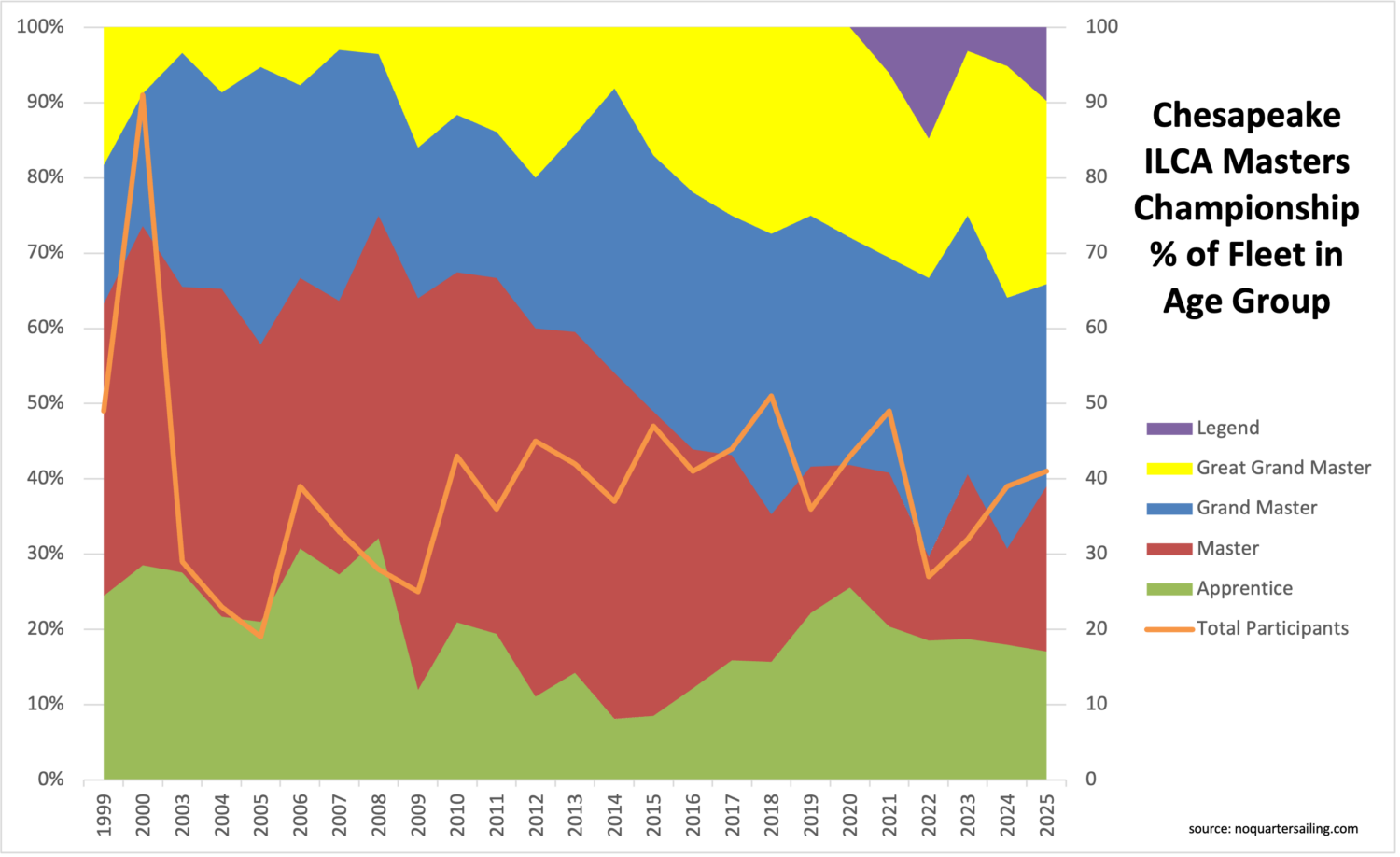
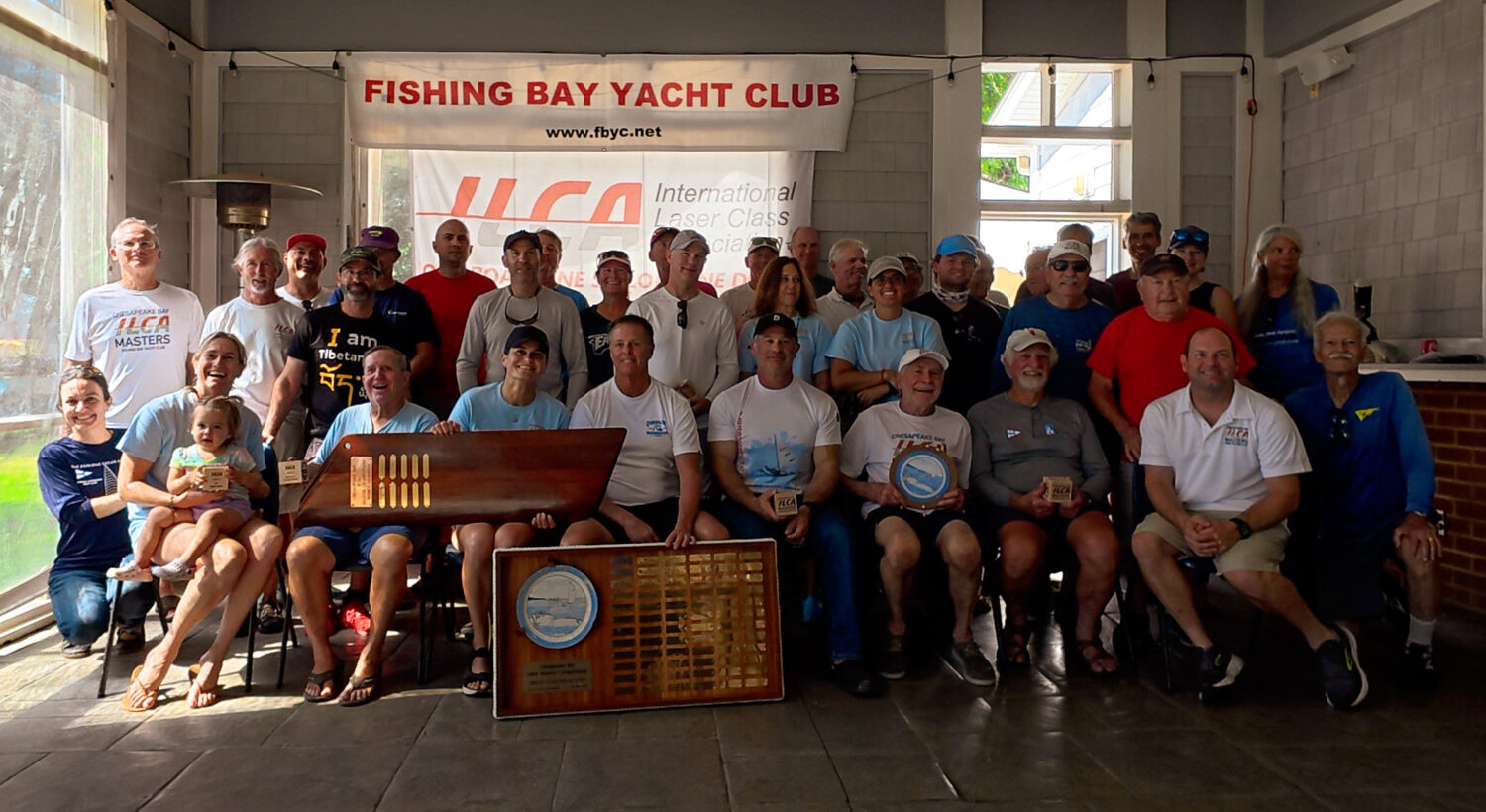
The 44th Chesapeake Bay ILCA Masters Championship wrapped up this weekend with three races on Saturday — the only races we managed to fit in before the wind completely disappeared.

As the event chairman, my regatta began weeks earlier: coordinating volunteers, designing t-shirts, getting registration open, and finally pulling together all the last-minute details that make the weekend run smoothly. By Thursday evening, I was at the club unloading gear and taking in a spectacular sunset over Fishing Bay – a calm start to what would turn out to be a very light-air weekend.

Friday was all about setup and organization. Competitors started rolling in by afternoon, and I spent much of the day helping sailors unload and get settled. That evening, I helped make race committee lunches and run through a few “what if” plans with the PRO – particularly what we’d do if Saturday morning brought the forecasted calm.

Sure enough, Saturday morning delivered exactly what we expected: no wind. Working with our PRO, we made an early call to postpone racing before the skippers’ meeting so no one had to rush to rig up. The forecast hinted at a late-afternoon breeze, so we mapped out the latest possible start time that would still get everyone home before dark.

Luck was on our side — around 1:30 p.m., a light easterly began to fill in. We dropped the postponement flag and got the first race off at 2:30. It wasn’t perfect breeze, but it was steady enough to race without a guessing game over wind direction.

The first race was a one-lap, modified windward-leeward. I didn’t get off the line well – squeezed out mid-line – but found clear air to the right and salvaged a mid-fleet finish in 16th. Up front, Dave Chapin, Alex Jacob, and Rob Whittemore showed great pace in the tricky conditions.

Race two started with more pressure and tighter racing. I got off cleanly about two-thirds down the line, tacked back to the right early, and rounded the top mark in fourth. I lost a few boats upwind after sailing into a patch of nothing, but clawed back one or two on the final downwind to finish ninth. Mike C and Laura were right in the mix – it was great, close racing all around.

For the third and final race, the course shifted slightly right. I went hard right on the beat, but couldn’t quite make it pay off. Rob W nailed this one, sailing a textbook race to take the win. With daylight fading, that was it for the day – three solid races in the books.

Back ashore, Alain and his team served up a fantastic dinner that evening. Alain’s longtime friend Michel shared stories of how he first got Alain into sailing decades ago ago. We lingered over good food and conversation before heading to the camping area to unwind under clear skies.

Sunday morning dawned calm once again. We postponed and waited, but it soon became clear the breeze wasn’t coming. Racing was abandoned, and Saturday’s results stood – putting me as the top Apprentice Master in the ILCA 7 fleet.

Huge thanks to Rick and the race committee for making the most of the conditions and running great races when we had the chance. Thanks also to Alain, Michel, John G., Janice, Jess, Sabri, Britt, and everyone else who made things run smoothly off the water.

Even with the light winds, the 44th Chesapeake Bay ILCA Masters Championship was a success – a weekend of good sailing, good food, and even better company.

PICTURES | RESULTS | VIDEO

Rain cleared the way for a nice sailing day – albeit a cloudy one with some puffy conditions. Four ILCA sailors made it out for what would be 3 races before rain chased everyone off the course.

The first race started with winds in the low teens out of the East with a course set just south west of Stove Point on the Piankatank River. I had a great start at the boat. Len had a better first leg out to the left side of the course and lead at the first windward mark. As we were coming to the final hundred yards of the downwind leg I set a course to intersect with Len while on Leeward pushing him out to the right and once we neared the 3-length circle and went for the finish, I was able to blanket him just enough to finish ahead by a foot or so. Mike was not far behind as was Holly.

By the second race the wind eased a bit with 10-12 knots out of the same direction. Len had a better start at the boat and just stayed ahead the entire upwind. Downwind he caught a nice puff on the right and took that to the finish without any challenge from me.

In the 3rd race I started mid-line with Len just below me. Seeing I wasn’t going to get by him, I tacked to the right out into the river where I found more pressure. I carried that into the top mark with a nice lead and then went the same way Len did downwind to catch the wind/wave angle and took off to finish 1st.

All throughout the afternoon rain threatened and we could even see i 2-3 miles west of us raining on the Piankatank and we only got a few sprinkles where we were. But after 3 races we weren’t going to try our luck with more rain and were safely ashore and packed up as the rain did eventually come. Thanks to Donna and crew for running our races!

PICTURES | RESULTS | VIDEO

The Summer ILCA Regatta at Fishing Bay Yacht Club delivered exactly what mid-summer river racing so often does: light air, close boats, and races decided by pressure bands and timing rather than pure speed. Seven ILCAs made it to the line just west of Stove Point on the Piankatank River, with a soft 5-8 knots filling from the southwest. The big question of the day was whether the sea breeze would hold long enough to keep things sailable.

Race 1 got off cleaning and wrapped up quickly, finishing in about 25 minutes. I had a solid start at the boat end while most of the fleet lined up farther down the line. Heading left on the first beat paid off, and I rounded the weather mark in first with Rob close behind. He found better pressure downwind to the north and managed to slip past me on the run. We split again on the final upwind, and Rob edged me out by a bout a boat length at the finish. With the breeze sitting in the 5-6 knot range, it was light but still workable.

In race 2, the race committee shortened the line slightly but kept the same course. I arrived at the start a bit too quickly and in traffic, so I ended up bailing out and wrapping behind the fleet to start on port. I quickly got back onto starboard, setting up as the right-most boat. That decision paid off immediately – the pressure on the right was noticeably stronger, and I was able to stretch away upwind. I was on the lay line without having to tack while the rest of the fleet coming from the left had to tack to fetch it. I had a clear lead at the top mark with Rob behind me the rest of the way to the finish.

With the scores tied going into Race 3, the pressure was on. I went all-in at the pin, but arrive a little too early and was OCS. After being called back, I rounded the pin and got to work grinding upwind, hunting for puffs. A few lifts brought me back into contention, and I wasn’t far behind Mike Moore at the top mark. I followed him downwind and briefly thought I might reel him in, but he found a solid puff and extended again. On the second upwind I couldn’t quite match the pace and Rob slipped past me. I finished in third, putting me second overall, one point behind Rob, with Mike M just one point behind me.

Race 4 was pure start-line chaos. A big left shift hit just before the gun, and Mike Moore pinned Rob and Ron at the pin, leaving them unable to tack out. The rest of the fleet escaped to the right with good pressure, including Mike Colbert, John Gilmour and Holly. I was a bit late off the line while trying to protect clear air and initially found myself being Mike C. Eventually Mike Moore crossed and forced me to tack, but I worked back to the right in to a nice lane of pressure. I stayed ahead of Rob, got around John and slowly reeled in both Mikes upwind. Downwind, though, I couldn’t quite close the gap and Mike and Mike finished ahead.

Mike Moore sailed a strong final race to win the regatta by a couple points ahead of Rob and me – congrats Mike. Thanks to David Clark and crew for running races today.

PICTURES | RESULTS | VIDEO

The 86th Annual One Design Regatta at Fishing Bay Yacht Club began under light and challenging conditions on Saturday. With little wind at the scheduled start time, racing was postponed for about an hour before the race committee was able to get one race underway in the Piankatank River. Even then, the breeze faded significantly as the final fleets were finishing. After waiting on the water for another two hours with no wind in sight, the remainder of the day’s racing was abandoned and competitors were towed back to shore.

The ILCA fleet saw 10 boats on the line. James and David established an early lead in the opening race and maintained their advantage throughout. Conditions proved difficult, and I struggled to stay in the breeze and find favorable shifts, finishing 8th.

Sunday brought a much-improved forecast and racing began an hour earlier. I launched early and had time for a short practice lap before the first start. The fleet completed a short H3 course before waiting for the other classes to finish and for the course to be adjusted as the wind shifted right.

Throughout the day, I began to feel more comfortable in the boat. Early races were marked by inconsistent decisions and sailing out of phase, but by the final race, things began to click. I had a strong start and was first to the weather mark, though Dave passed on the reach and maintained his lead. On the final downwind leg, James caught up and edged ahead at the finish.

Despite the ups and downs, I finished 4th overall, narrowly securing the position. Thanks to Rick, Holly, Mason, Craig, and the entire race committee team for making the regatta possible.

PICTURES | RESULTS | VIDEO

Twenty-four boats, including two Lasers, lined up under sunny skies and light winds for a distance race on the Piankatank this July 4th at Fishing Bay Yacht Club. With breeze holding steady around 5–6 knots from the NNE, the fleet saw a short postponement before starting under a single unified start. The course (#4) would take the fleet from Godfrey Bay – out around Stove Point and back.

After the start I favored the left side of the course sailing toward Stove Point and picking up a bit more pressure. However, once past the point, an adverse current set in and allowed boats on the right to gain an advantage by the time we reached the Piankatank 8 mark.

The leg to mark B was a close reach, where I managed to close the gap on Scuba Cat. On the return leg, the Flying Scots began to reel me in and momentarily pulled ahead.

The final two legs from Piankatank 8 to the finish were broad reaches in continued light air. I was able to regain ground on the Flying Scots and ultimately pull back in front of Scuba Cat.

Out of the 23 boats that finished the race, I crossed 14th but placed 7th overall on corrected time. Thanks to Miles, Frank and everyone on the RC for running our race!

RESULTS | PICTURES | VIDEO

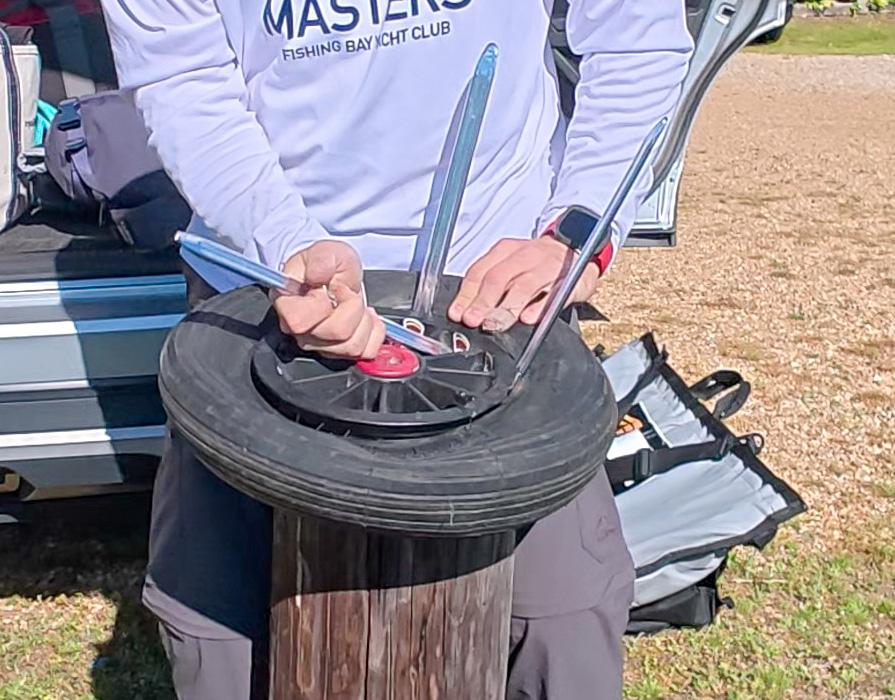
You come back to your boat after some time away—and find the dolly tire is flat. You could pump it up, and that might work for a while but chances are it’ll eventually go flat again. Most likely, the inner tube has failed. Here’s how to replace it:

What You’ll Need

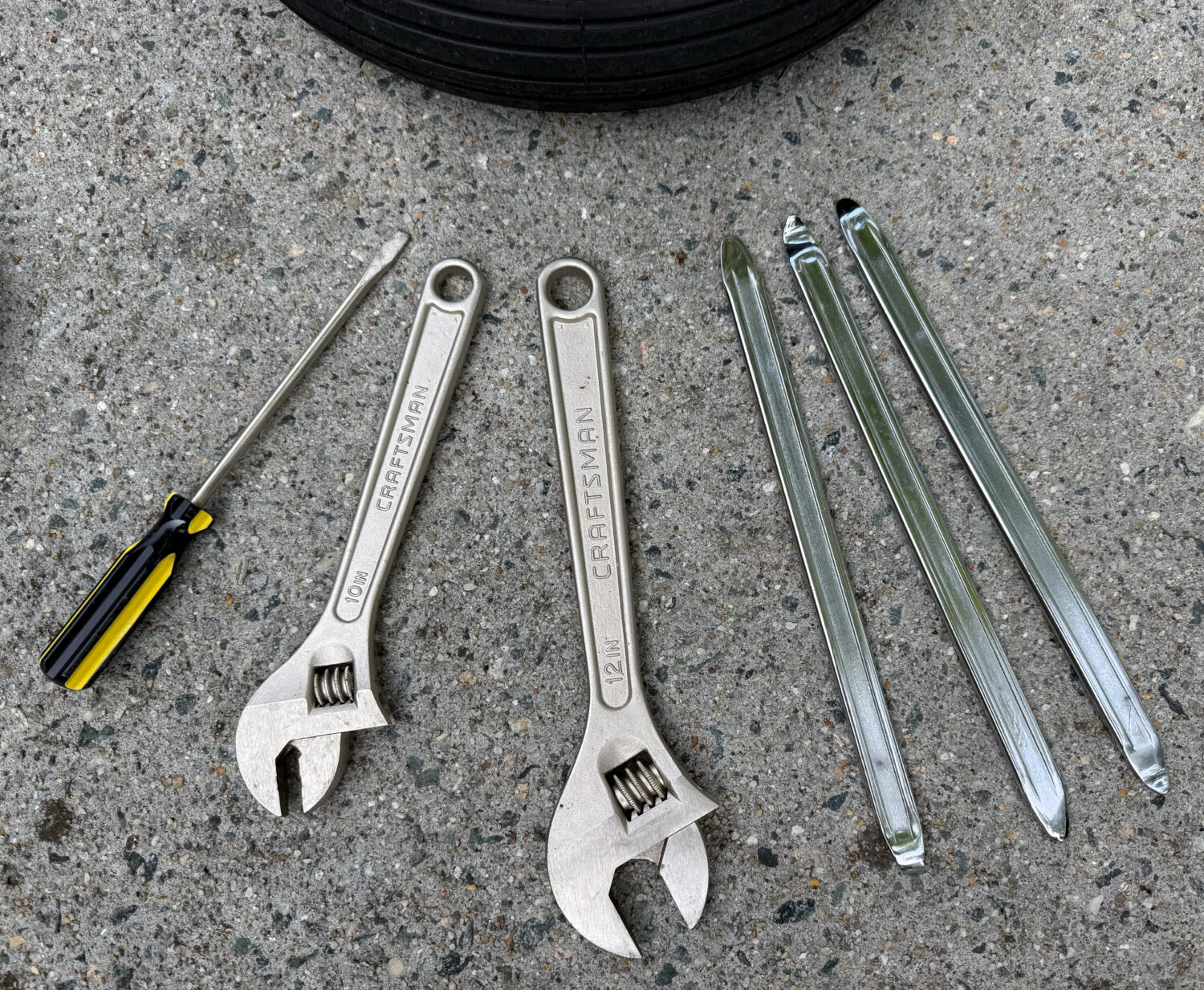
  • Tire irons (motorcycle-style preferred): Example on Amazon
    You can substitute with large flathead screwdrivers or the handle of a wrench, but be careful – these can damage the tube or rim.
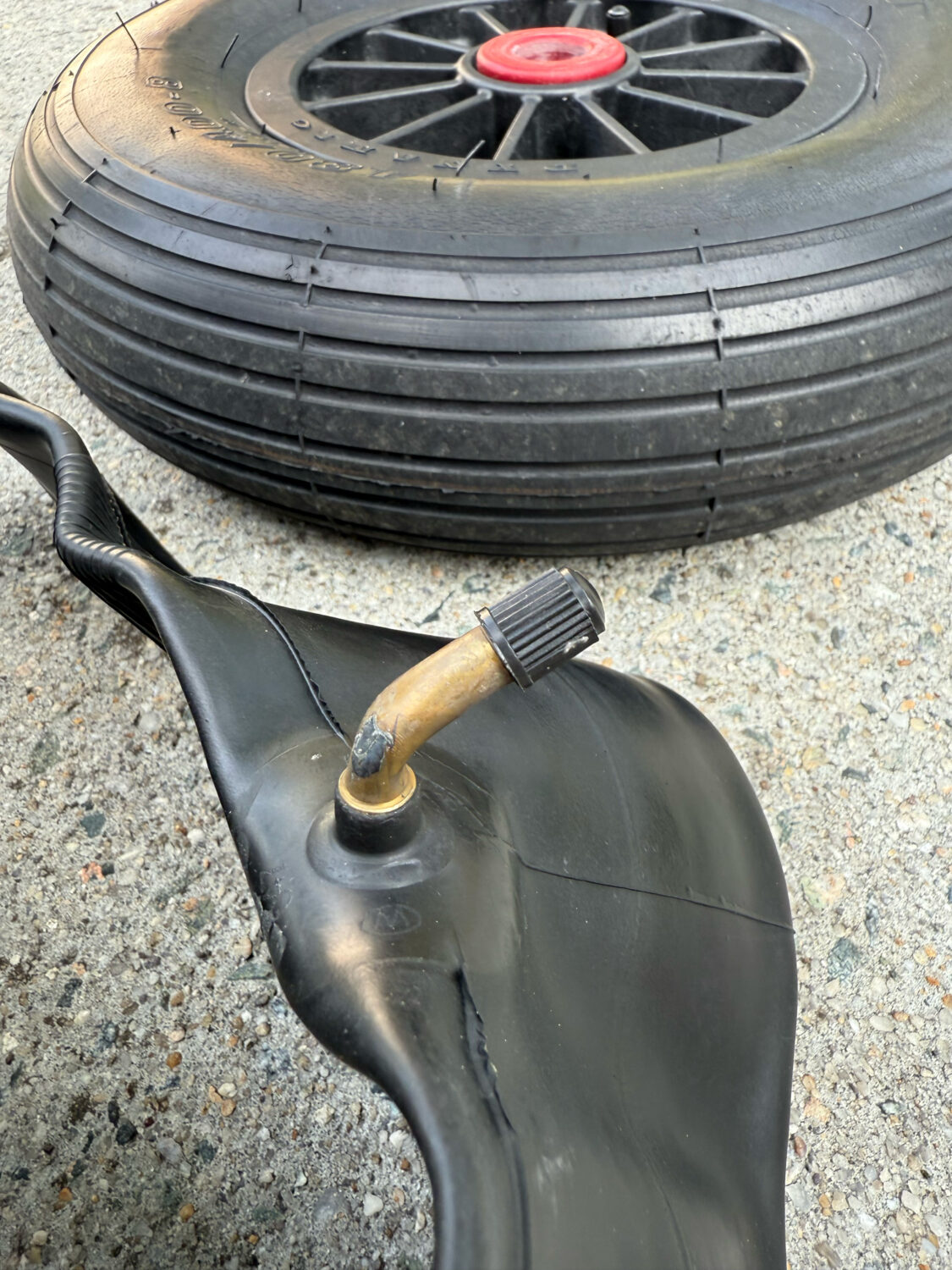
  • Replacement inner tube (4.80/4.00-8 size) with an angled valve stem: Here’s a good option

I recommend using proper motorcycle tire irons—they’re smooth, light, and long enough to give you leverage without damaging the rim or tube.

Tools and materials needed to change a tube

Step-by-Step Instructions

1. Deflate the Tire (if it still has air):
Squeeze out as much air as possible. A completely deflated tube is much easier to remove. If you can’t get to the valve stem to deflate it, you may need to cut it after removing one side of the tire.

2. Remove the Tire from the Rim:
Use your tire irons to work one side of the tire off the wheel. This will take some force, but don’t overdo it—Dynamic Dolly rims are plastic and can bend or crack under too much pressure. Watch the video to see how it’s done.

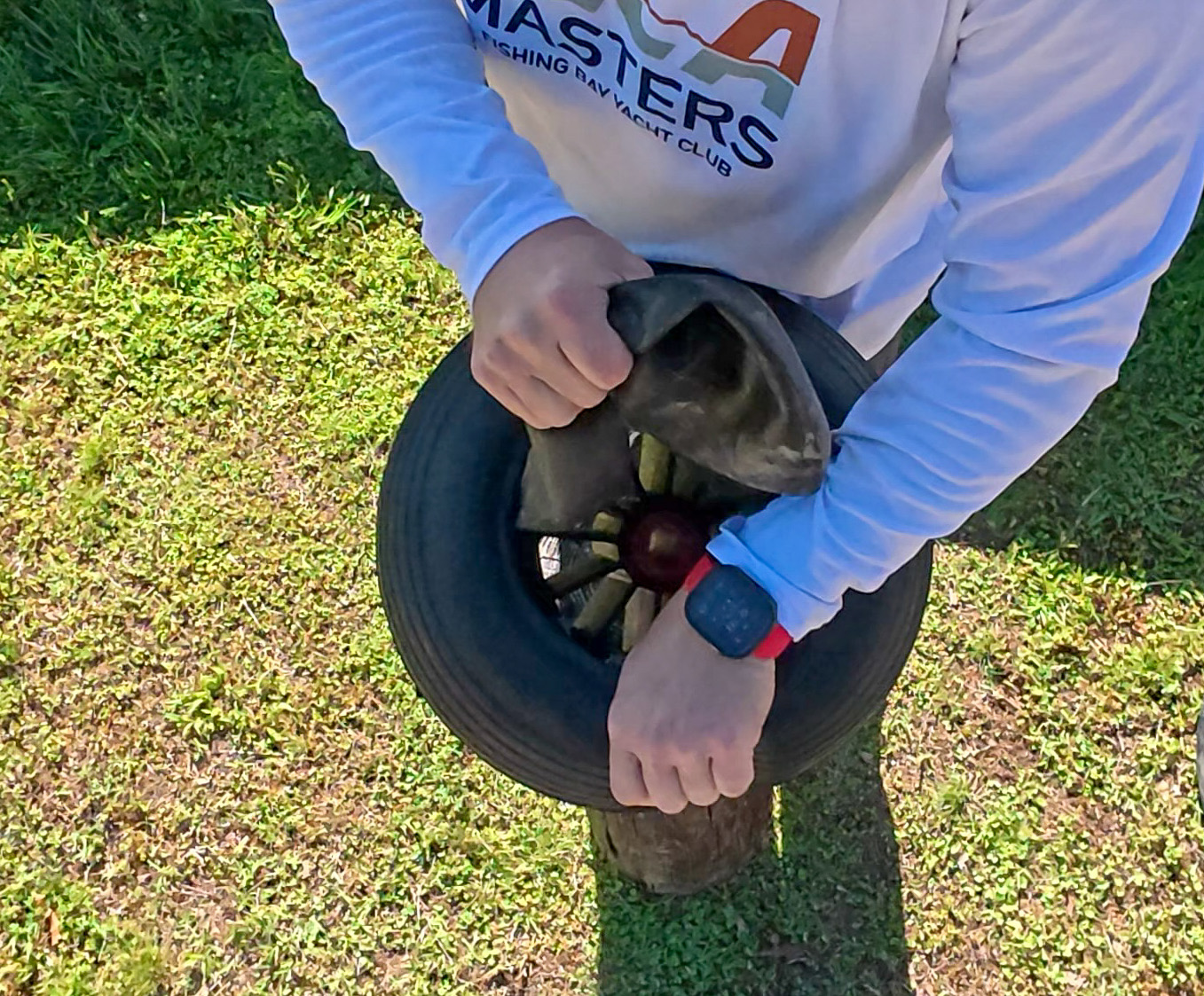
3. Remove the Old Tube:
Once one side of the tire is free, pull the tube out. Cut it if necessary to make removal easier.

4. Insert the New Tube:
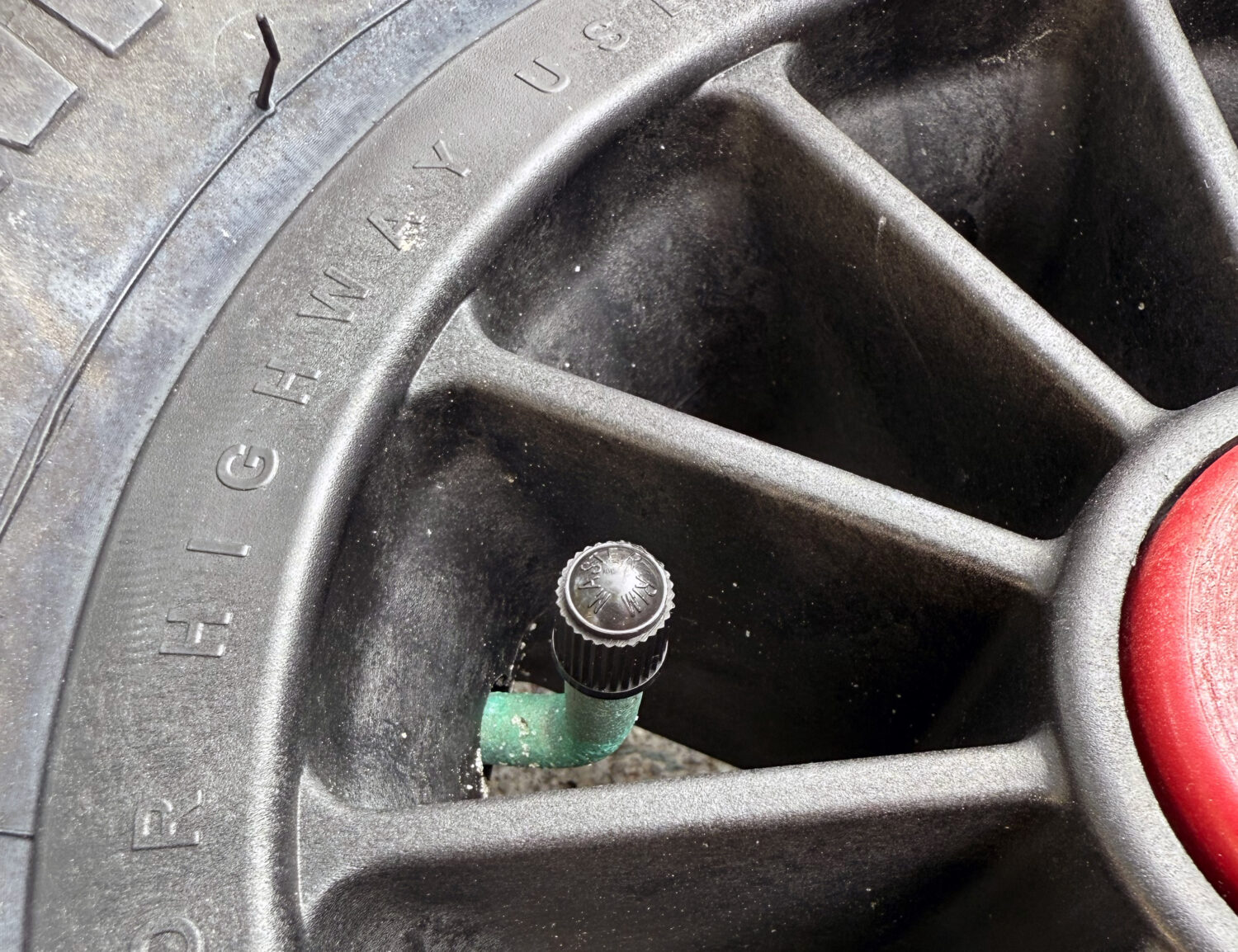
Place the new tube inside the tire, aligning the valve stem with the hole in the wheel.
Tip: Hold the valve stem in place through the hole while you work the rest of the tube into position. Note: there may be two holes in the wheel for the valve stem – only one lines up with the angled stem.

5. Re-seat the Tire:
Carefully work the tire edge back over the rim using your tire irons. Be gentle—don’t pinch the new tube, especially if you’re using improvised tools.

6. Inflate the Tire:
Pump the tire to 10–14 psi, depending on your needs. Make sure the tire is seated evenly all the way around.

7. Install the Valve Cap:
Always use plastic valve caps in a marine environment.
Avoid metal caps—they corrode and can seize onto the stem over time.

8. Reinstall the Wheel on the Dolly.

Disclaimer: As an affiliate in Amazon’s program I may receive a commission for product links.

Friday

Last weekend I headed to Annapolis for the ILCA Atlantic Coast Championship at Severn Sailing Association. With over 100 boats across three fleets, it promised competitive racing-and delivered plenty of challenges. Here’s how the weekend went.

I arrived on Friday and after a quick trip through downtown Annapolis, I arrived at SSA, unloaded and got things ready for sailing.

Saturday

Rain swept through the area in the morning, clearing out just in time for rigging. With skies brightening and a west wind building from 10 to 14 knots – and gustier as the day went on – it looked like we were in for a pretty epic day of sailing on the Chesapeake Bay.

After the skippers meeting I grabbed a few drone shots of the rigged boats across the campus as they started to launch. I got myself launched and sailed 2.2nm out to the course.

About 10 minutes before the first start I went to tune up sailing on starboard for a minute or so, I made a few rig adjustments and tacked onto port. About 20 seconds later –crack– I heard a pop, lost all pressure in the sail  As I heard the top of the mast hit the water next to the boat I balanced the boat as I pulled myself back in.  I had broken the top section of the mast just above the collar where it joins with the lower section. There was a gaping hole with now two ends of the mast sticking out of it.

I grabbed my mainsheet to make a tow line and a few minutes later one of the power boats picked me up for the tow in. Back ashore I quickly took the boat apart, retrieved my wallet and a spare sail and bought a carbon fiber top section to go back sailing with. By the time I got back to the course, the fleet was still mid-way through the first race-delayed by a major wind shift that forced them to abandon the initial attempt.

I joined in the second race of the day. The breeze was now a solid 12-14 knots, with some early whitecaps. I started near the committee boat and had a solid first leg, rounding somewhere around 8th or 10th. But I couldn’t hold position. I lost boats on the downwind and struggled on the second beat, eventually finishing 14th.

Race 3 got off to a strange start. As the fleet neared the weather mark, the buoy broke loose and began drifting downwind. A few boats chased it; others correctly rounded the committee boat, which was now flying the M flag. The race was eventually abandoned after sailing another lap.

The second attempt at Race 3 finally got off clean. By now, depowering the rig was a challenge. The breeze was shifty and strong out of the west, tough conditions to find a rhythm. I gave it my best but couldn’t quite stay competitive, finishing 17th.

The sail in was punishing. The wind had continued to build, and the 2-nautical-mile upwind slog back to the harbor was a workout. The weather buoy later confirmed: we’d raced in upper-teen winds with gusts into the 20s.

Sunday

Sunday’s forecast promised even more breeze and it delivered. By the time the fleet was getting ready to launch the weather buoy was already showing winds into the 20s. I knew the fun factor was not going to be there for me in that wind, so I packed up.  Just before the start there was a gust to 35 before it settled down to 18-23 for most of the days racing.

I made the right decision and went to visit the J/42 that I’ll be sailing on for two upcoming distances races out of Annapolis in the coming weekends.

PICTURES | RESULTS | EVENT WEBSITE | VIDEO

The trip that began before it began – with snow forecasted in the days before I was set to leave, I packed the boat a week early so I wouldn’t have to be out in the cold loading everything up.  When the weekend arrived, I was able to brush the snow off the boat – a first for me – and get on the road to Florida.

Driving Saturday was relatively uneventful with no significant traffic.  I made it 10 hours to Daytona got a hotel just outside of the speedway. I went for a run towards the grandstands and saw some of the bike week setup. This place will be packed with motorcyclists a week from now.

Sunday

Since I was only a couple hours from the sailing center, I decided to do a tour of the speedway and I got there for the first tour of the day. The drove us around to see the track and facilities. We got to walk on the track at the start finish line, see how banked the corners are and walk into the grandstand.

I finished the drive and arrived at the sailing center just after 2pm. I drove 870 miles in about 13 hours of drive time.

Very few ILCA sailors were there, just a couple others who skipped the Friday-Sunday event that was just wrapping up in West Palm. Rob E helped me unload. I rigged, tested some camera setups and headed out. On the water I med up with Paul C who was sailing an ILCA-6 while I was in an ILCA-7 and we spent an hour going upwind and down on our own made up course with .5 mile legs.

Back ashore I derigged the boat and few of the sailors from West Palm started arriving and unloading. As the sun set I put the drone up to get some pictures of the sailing center.

Monday would be spent working remote from the hotel on what would mostly be a rainy day.

Tuesday

By Tuesday morning 86 boats had assembled for the first day of racing. Following a skippers meeting we launched and headed out to the course in some pretty good wind out of the north at 15-18 knots.

First race I had a slightly late start at the boat and went out to the right in clear air. I stayed to the right rather than crossing most of the fleet and getting to the left as the wind went that direction and found myself at the top of the bottom 1/3 of the fleet at the top mark. I picked up a few spots around the course to finish 25.

We started the next race and I was again at the boat and went right. There was a huge lefty and I got clobbered up the first beat.  Halfway down the run something wasn’t right, boats ahead weren’t rounding and then the marks were picked up. They had abandoned the race on account of the wind shift and never started the ILCA-6 fleet. Was a shame to spend all of that energy on a windy day on half a race, but at least we’d have a better chance at a better result.

For race 2 we stared under the Y flag. I did a good job winning the boat and again stayed right and carried it as far as I could.  Then I made my way back left with just a few other boats with me and punched out, and James Jacob just a little more left of me. As we got to the top mark we were the first two there and traded tacks. He got to the windward mark first, but had to round wide and I got the inside as we went to the offset mark where I rounded first. James and another boat went a little more down the right side of the course as I stuck to the left and I managed to hold my own rounding the gate in 4th as some of the faster boats started to catch up. Unfortunately, from there I’d make a few mistakes on the beat and lost about 10 boats – settling for 14th.  Still a respectable finish and certainly the highlight of the weekend to lead a race at least for moment.

By the 3rd race of the day I was pretty tired. The wind was still blowing and we had to wait a while for the radials to finish. When they did try to start us, they blew it off just before the start to reset the line. Once reset, a race was started and I started at the boat again and went right finding myself in good company with James and Mark B. Luckily the wind went right and we were in the top group. I didn’t have the strength to hike on the very long leg and was just out of the top 10 at the first mark. I mostly held my position and dropped only a couple positions for a 15th place finish.

Wednesday

Wednesday was a lighter day and we sailed out and postponed for an hour. Once some wind in the 8-9 knot range did come in, they got us started and I had a terrible start right between Don H and Patrick W who rolled right by me and left me in bad air. I just worked on finding clear air and picking shifts and did well to climb back into the middle of the fleet. By the second leg I was up to almost 10th, but lost a couple boats downwind and finished 16th.  Great result given the start.

In race 5 I had a terrific start on the middle left of the line and carried that to the left – only it was too far and I missed some opportunities to get back right when the pressure and shifts were there. Made a couple mistakes to slow myself down coming out of the leeward gate, never got it going to pass anyone and finished 32.

By the final race of the day the wind had eased to 6-7 knots of wind. I was pretty late starting at the boat and just watched everyone sail by. Never felt like I could get in pressure and get the boat going and settled for a 26

Thursday

On Thursday the forecast was for no wind. We arrived to no wind, saw no wind, had no reason to believe wind was coming and after postponing onshore for about an hour, racing was called for the day. I did a run in the park near the sailing center and headed back to the hotel for some work before joining a group of D11 sailors for dinner.

Friday

With no racing yesterday, the start time was moved up to 0930 and 4 races were planned. At that time in the morning, the light on the course is fantastic. The wind was 10-11 as we headed out, but quickly fell to 7-8 as racing started. There was current sweeping us over the line and it was reset a time before we got a clean start under black flag. I didn’t time the start well and was in the back of the pack all the way around the course and finished that way.

After waiting for the radials to finish their race – they weren’t started until we were almost finished – I was determined to get a better start. I was right on the line near the middle right on time with a good lane and a few boats around. Unfortunately, the mainsheet slipped out of my hand – I saved myself from flipping to windward, but parked the boat for a second. I still had somewhat of a lane and was just about to tack to port into a hole when the boat just to leeward and ahead of me started yelling for me to tack. I wanted to hold my lane for a just little longer before tacking, but (conversations after racing would confirm) he seemed to think he was entitled to tack since he thought I wouldn’t want him leeward/ahead even though I had right of way and he wasn’t really affecting my wind. And so he tacked forcing me to duck him in order to not T-bone him and the hole I had hoped to tack into was gone. I immediately protested, he didn’t turn and he ended up dropping out just before the protest was to be heard. I would sail the rest of the race in the middle of the fleet finishing 29th.

For the 3rd race of the day – I again got shot out the back. Only solace was starting to figure out where the lane of wind was and the patterns to the shifts. I picked up a few boats as I went and finished 26th.

The final race of the regatta would start the worst and finish one of my best. I was late to the boat and due to traffic took hitting the committee boat (stand off buoy) over tussling with other boats. After I did my turn and started the race behind almost everyone, I had a great view of the wind from the boats ahead. I set to work in the lane of wind I discovered in the prior race and picked off 10-12 boats in that first upwind leg. I’d do it again in the second beat and got up to 16th by the finish.  Imagine where I could have ended up with a better start.

I ended up 25th overall and the second Apprentice Master. It was a nice trip to experience some warm weather, see a new venue and spend a week of sailing with some ‘old’ friends.

PICTURES | RESULTS | VIDEO

We had great weather for the final ILCA regatta of the season at FBYC. With 10 ILCA on the line we had mostly sunny skies with winds starting in the 10-15 range and easing down to 5-8 as the day went on. The wind was out the the North so the course was set in the middle of Fishing Bay to have enough fetch, but not be so far away.

I started the first race by being early at the boat, was called over and had to go around the boat to restart. The rest of the day went a little better with mostly middle of the fleet finishes. The very competitive fleet made it so every place was hard-earned racing. Definitely enjoyed having so many people come join. Probably wasn’t my best day on the water after a very long day yesterday and an early morning today commuting to Deltaville from Richmond all weekend.

Thanks to Gene Kendall and his team for running races today.

PICTURES | RESULTS | VIDEO