Friday

I made the trip to Erie, Pennsylvania for a weekend of ILCA masters racing at Erie Yacht Club. I arrived just after noon on Friday, unloaded the boat, rigged, and headed out to see what Lake Erie had to offer before racing began.

There wasn’t much wind in the bay, but the larger boats out sailing looked to be moving, so I sailed down the bay and through the cut into the lake. About an hour later I reached open water where the breeze was a little better, giving me another hour of worthwhile practice before turning back.

By then the wind had faded again. The evening parade of powerboats heading home for dinner turned the cut into a washing machine, and without much breeze it became a slow battle just to make progress. I eventually made it through and continued drifting back toward the yacht club in almost no wind. I probably would have made it eventually, but Gavin came out in a powerboat and spared me the last part of the journey with a tow back to the dock.

Saturday

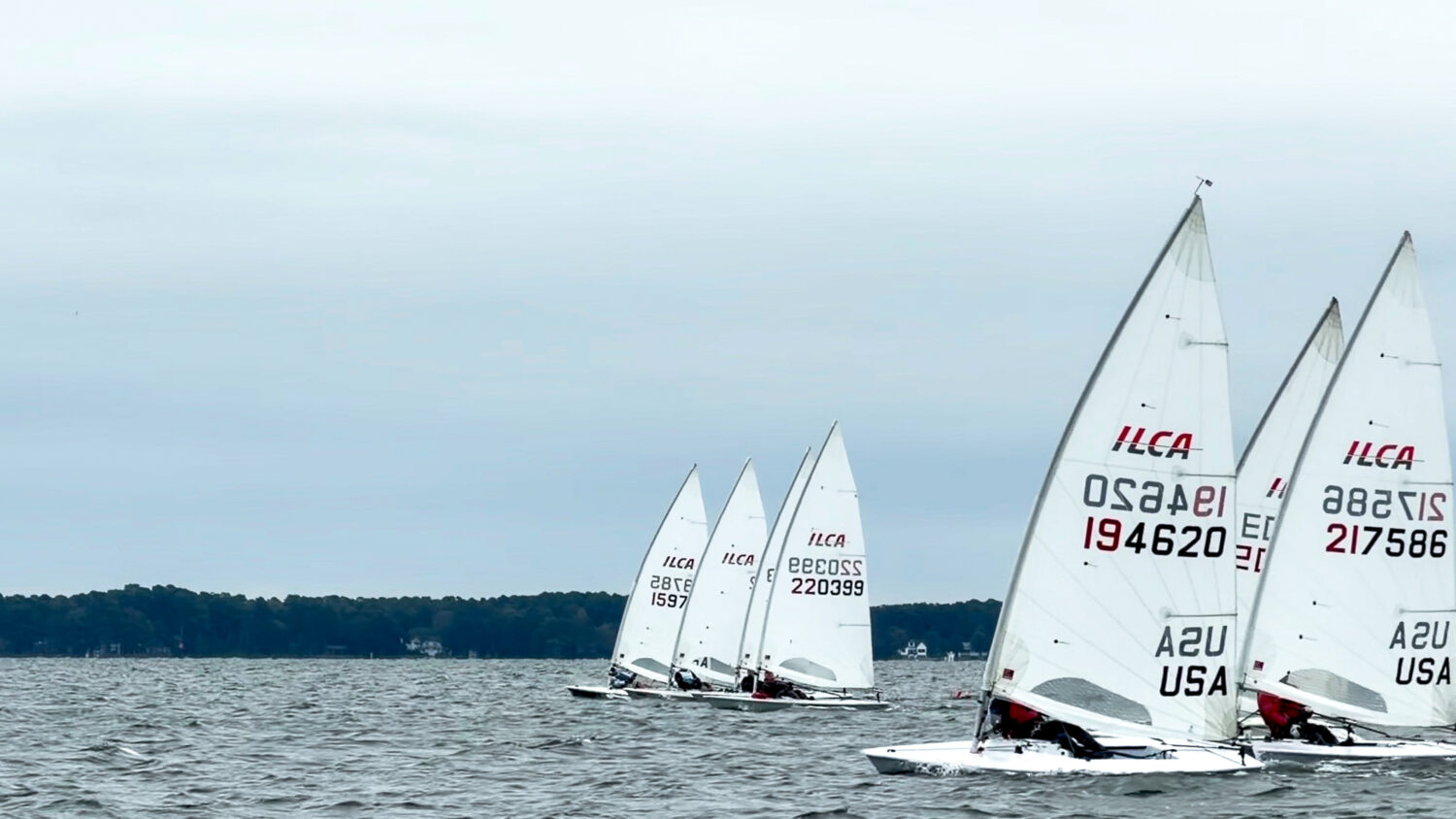
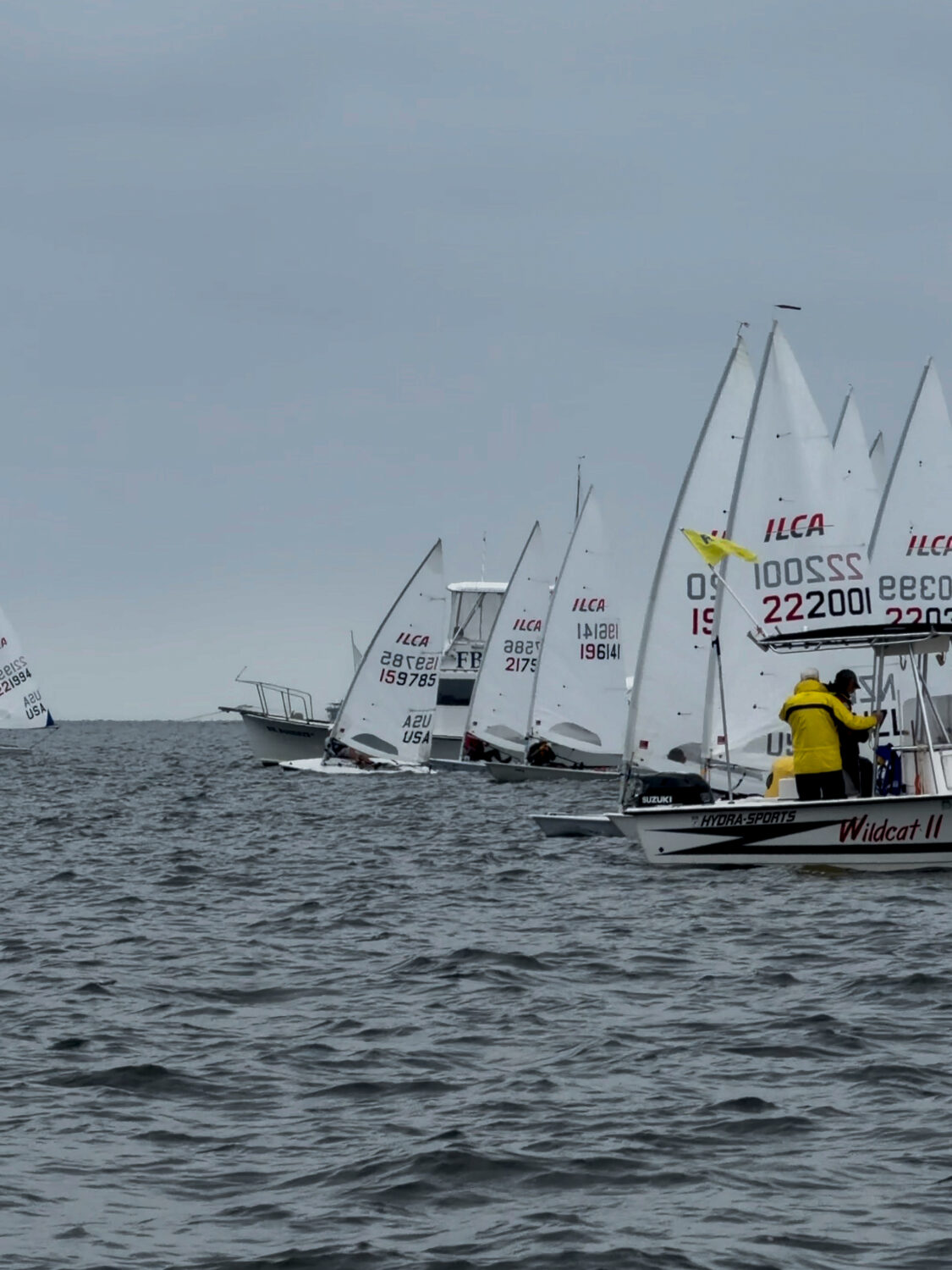
Saturday brought the first day of racing with 30 boats entered. The forecast wasn’t especially promising, and after everyone rigged we spent about an hour and a half postponed ashore waiting for enough wind to fill across Presque Isle Bay. Eventually a light northerly settled in, we launched down the single-lane ramp, and headed to the race course.

The first race was about as light as they come. I won the pin-end start and worked left, but the pressure never materialized where I expected it. By the time I crossed back, the left side had finally filled and I had dug myself a deep hole. The race was long, slow, and eventually shortened, and I held position to finish 16th.

By the second race the breeze had built into the 5-8 knot range. It was still light, but it was at least becoming a sailing race instead of a guessing contest. I again started well at the pin and worked left before finding myself farther back than I wanted around the first mark. The downwind leg was respectable, but the biggest improvement came on the second beat. With steadier pressure I could simply focus on boat speed instead of chasing every puff, and the boat felt great upwind. I picked off five boats on that leg and climbed to ninth.

The final race Saturday featured another solid start, this time from the middle of the line. I rounded the first mark around 12th or 13th and continued to feel fast upwind. After a course change on the second beat, I found good pressure on the right side and picked up a couple more boats to finish eighth.

Sunday

Sunday greeted us with more breeze, generally in the upper single digits to low teens, and three more races.

The first race of the day was my strongest of the weekend. I had an excellent start near the pin and rounded the first mark in the top five after keeping the maneuvers to a minimum and focusing on staying in phase. A crowded downwind leg cost me a couple of places, and another boat squeezed by at the final leeward mark to leave me with another eighth-place finish. Even so, it was satisfying to spend most of the race mixing it up near the front of the fleet.

The next race was another lesson in staying patient. The right side paid early, leaving me around 15th at the first mark, but I found some nice shifts on the second beat as the breeze began to soften again. Picking through the fleet, I worked back to an 11th-place finish.

With one race left, the overcast skies continued to threaten without ever delivering rain, and we still had enough wind for one more good race.

For the final start I committed to the boat end, but in trying to hold a couple of boats out I stalled myself and watched the fleet sail away. After tacking immediately to the right, I focused on keeping the boat moving, minimizing maneuvers, and looking for pressure rather than chasing every shift. That patience paid off on the second beat when a left shift and stronger pressure allowed me to pass at least ten boats and climb back into the top ten, finishing tenth after what looked like a very difficult opening lap.

Considering the forecast, the weekend turned out far better than expected. Aside from the closing part of the first race, we had enough breeze to complete a full six-race series and enjoy some competitive sailing.

A big thank you to Gavin and Holli for organizing another great event. Erie Yacht Club put together an enjoyable regatta, and it was well worth the trip to Lake Erie.

RESULTS | PICTURES | VIDEO

On my way to a weekend regatta in Erie, Pennsylvania, I added a couple of days to the trip to explore several rail trails and other interesting riding areas in Pennsylvania and New York.

After work on Wednesday, I drove to Breezewood, Pennsylvania, to position myself for an early start the next morning.

Thursday began at 6:00 a.m. with a ride on the abandoned section of the Pennsylvania Turnpike. About eight miles of the original turnpike, abandoned when the highway was rerouted in 1968, has been converted into a bike path. I only saw one other person on the ride in and had the trail to myself for the remainder of the morning. I was surprised by how much of the original road markings and guardrails were still in place after nearly 60 years. The tunnels were in good condition and well swept. The surface is better suited for a gravel bike than a road bike, and it made for a unique place to ride.

After returning to the hotel, I showered, took a short nap, and then drove to Oil Creek State Park.

I parked at the southern end of the park and followed the rail trail north into Titusville before taking a partially gravel road back into the park. That section included several long climbs and descents, making it the most physically demanding ride of the day. Along the route I caught what I believe was the back half of a bear crossing the road in the distance. Eventually I rejoined the rail trail and returned to my starting point. Before finishing for the day, I rode a nearby hill with grades of about 12% on the climb and 11% on the return. After a full day of riding, it probably wasn’t the smartest addition to the route.

Once finished, I packed the bike, changed clothes, and drove to Mayville, New York, for the night.

Friday morning started on the Webb Nature Trail, part of the Chautauqua Rail Trail system. The trail began with a well-maintained gravel surface before becoming muddier and grass-covered in the middle section, then improved again approaching Sherman. It was slower going than the previous day’s rides because of the changing conditions. On the return trip, I rode through Chautauqua Gorge Park before making my way back to Mayville. With some time left before heading out, I picked up another section of the Chautauqua Rail Trail on the opposite side of town and rode about a half mile before turning around.

Back at the hotel, I washed the bike, showered, checked out, and made the short drive to Erie for the weekend’s sailing regatta.

PICTURES

The Islander Regatta had been on my radar for a few years, and I finally had the opportunity to participate. The regatta is a human-powered circumnavigation of Gwynn’s Island in Mathews, Virginia. I frequently sail and paddle around Gwynn’s Island, but making it all the way around in a small sailboat or on a paddleboard is usually a little farther than I’d want to do on my own. Doing it as part of an organized event made it a great opportunity.

The event started from the Islander Hotel at 8:00 a.m. on Saturday. The hotel is another place I’ve passed countless times by both road and water but had never visited. It operated until 2003, when it was heavily damaged by a hurricane. The building and surrounding property have seen only occasional use since then.

Around 80 participants launched from the beach in a variety of human-powered boats, including sea kayaks, recreational kayaks, paddleboards, rowing shells, and other craft, all setting off on the counterclockwise trip around the island.

After leaving the beach, we rounded the hotel property and entered the channel leading toward the bridge. Once under the bridge, we headed into Milford Haven on the west side of the island. As the water opened up approaching Hole in the Wall, the wind increased and the longer fetch built up small waves that struck from the side. That meant a lot of paddling on the left side to compensate for the wind and waves.

At the southern end of Gwynn’s Island, participants had a choice. Some elected to portage across the beach, cutting about a mile and a half from the route. Roughly a quarter of the boats, including mine, continued around the entire island without taking the shortcut.

Once we reached the eastern side of the island and entered the Chesapeake Bay, the shoreline provided more protection from the waves, and the wind eased considerably, especially along the stretches lined with trees and houses.

At the mouth of the Piankatank River, we turned west into the wind for the final leg of the trip. The last 2½ miles back through Hills Bay to the Islander required paddling into a light headwind and small waves before returning to the finish.

Pictures | Paddle Map

The Annapolis to Bermuda Race is a 753-mile offshore race that begins with approximately 120 miles down the Chesapeake Bay before turning east for another 630 miles across the Atlantic to Bermuda.

Our race weekend began in Annapolis with the Eastport Yacht Club’s skippers’ briefing. That evening we took Bay Retriever out for one final practice sail before gathering for a crew dinner, watching the sunset over the harbor, and finishing the last of the provisioning. After weeks of preparation, everything was finally ready.

Bay Retriever is a 2019 J/99, one of the newest and smallest boats in the fleet. Although only 33 feet long, the J/99 was designed specifically for offshore racing, with a simple sail plan and equipment built for long passages.

This wasn’t the boat’s first offshore challenge. Bay Retriever had already completed the 2024 Annapolis to Bermuda Race, the 2025 Annapolis to Newport Race, the Around Long Island Race, Block Island Race Week, and thousands of miles of additional offshore sailing.

Our crew of five brought a wide variety of experience. Sean has sailed to Bermuda multiple times and has years of experience as a professional sailing instructor and delivery captain. Ian combined offshore experience with dinghy racing and J/105 sailing. Cameron had sailed nearly every one of Bay Retriever’s 9,000 miles. Jon has extensive Laser experience and time on a J99 as well as completing last year’s Annapolis to Newport Race.

With 13 boats in our class, we knew our biggest competition would come from boats sailing at similar ratings, while several larger boats would likely finish well ahead of us.

FRIDAY

Race morning brought calm conditions and plenty of excitement around Annapolis Harbor. Spectator boats filled the water, the Pride of Baltimore was nearby, and family and friends watched the livestream from home.

Our plan was simple: start conservatively, and sail our own race. Instead, everything came together even better and Bay Retriever won the start at the committee boat end of the line, putting us immediately into clean air and allowing us to choose our own course through the light breeze at the top of the Chesapeake.

The forecast called for light upwind sailing down the Bay before reaching the Atlantic sometime the following afternoon.

As darkness fell on the first day, we were passing Solomons Island and settling into our watch schedule. Sean and I stood the first overnight watch while the rest of the crew tried to find sleep aboard a heeled-over race boat.

SATURDAY

By sunrise we were off the mouth of the Rappahannock River, making good progress south while the breeze held. We knew lighter conditions were expected later in the day, so we took advantage of every bit of wind we could.

Eventually the forecast caught up with us.

Near the mouth of the Chesapeake, the wind faded dramatically. Current became the dominant factor, and progress slowed to a crawl. At one point we even deployed the anchor in an attempt to avoid being swept backward. Whether it fully set or not, it reflected just how little wind remained.

The final miles out of the Bay became a frustrating series of tacks through shifting current and light air. What might normally take far less time stretched into nearly 30 hours before we finally cleared Cape Henry and entered the Atlantic.

Once offshore, the breeze steadily returned. We hoisted the Code 0 as the sun began to set and worked our way through commercial shipping traffic entering and leaving the Chesapeake.

Gradually the constant chatter on VHF radio faded as the shoreline disappeared behind us. The boat settled into a comfortable rhythm, and for the first time it truly felt like we were offshore.

SUNDAY

The wind increased into the 20-knot range, and the seas built quickly as we approached the Gulf Stream. Much of the day was spent reaching under a triple-reefed mainsail and jib, occasionally surfing down waves at speeds approaching 18 knots. The motion below deck became challenging, and not everyone escaped the day feeling their best.

MONDAY

Monday morning began with a squall slowly building on the horizon.

As it approached, we reduced sail until we were carrying only a triple-reefed mainsail. Heavy rain swept over the boat while lightning flashed in the distance. Once the squall passed, it carried the wind away with it, leaving us briefly drifting in light air before the breeze gradually returned. By afternoon we were back under the spinnaker and making good progress once again.

TUESDAY

Tuesday, our final full day at sea, provided the reward after several days of changing conditions. Sunshine, steady breeze, and relatively flat water combined for fast, comfortable sailing toward Bermuda.

That evening the first lights of the island appeared on the horizon. Through the night we watched Bermuda slowly emerge from the darkness beneath a sky full of stars.

WEDNESDAY

Just after dawn, we called into Bermuda Radio who let us know about several cruise ships and the tall ship Sagres entering the harbor.

At 6:51 a.m., Bay Retriever crossed the finish line, completing 753 miles of racing.

After congratulating one another, we lowered the sails and motored around the island toward Hamilton, tying up at the Royal Hamilton Amateur Dinghy Club.

With the race complete, we enjoyed a few drinks dockside before clearing customs, cleaning up, and heading into Hamilton for our first meal ashore. That evening, sleeping in an Airbnb after nearly five days aboard the boat felt especially good.

THURSDAY, FRIDAY

Arriving on Wednesday left us with two full days to enjoy Bermuda before heading home.

We explored the island’s towns, beaches, and historic forts, watched a local parade, sampled plenty of great restaurants, and made sure to try both Dark ‘n Stormies and Rum Swizzles along the way.

SATURDAY

The week concluded with the awards ceremony, dinner, and celebration at the Royal Hamilton Amateur Dinghy Club.

PICTURES | RESULTS | EVENT WEBSITE | TRACKING | VIDEO

Saturday I joined a group of eight riders for my first Tour de Chesapeake, a bike rally that winds through the back roads and alongside the waterways of Mathews County, Virginia. Over the course of 55 miles, we traced a route that showcased the county’s mix of farmland, forests, and coastal scenery. For a first‑time experience, it was a great introduction to the event and a fun way to explore coastal Mathews County.

PICTURES

The Magothy River Sailing Association’s Spring Fling brought a difficult mix of light air and strong current on Saturday, reshaping what was intended to be a distance‑style triangle race just north of the Bay Bridge. The J/99 Bay Retriever made the trip up from Back Creek to take part in the event, which allowed boats to start at any of three marks and sail the course in either direction within a set time window.

Early forecasts suggested steady breeze and manageable current, but conditions shifted as the morning progressed. The leftover chop from an earlier 10-15 knot breeze remained, even as the wind faded.

Bay Retriever enjoyed the last of the usable wind during the hour‑and‑a‑half sail to the southernmost mark, sailing mostly upwind and against a strong southerly current. By the time the crew began their race around 11 a.m., the wind had dropped significantly while the current continued to run hard.

The team chose the counterclockwise option, which required two close‑reaching legs partly into and across the current before a downwind leg with the current toward the finish. With only 3-6 knots of breeze, lingering chop, and a strong opposing flow, progress was slow from the outset. After about ninety minutes, it became clear that the first mark was still roughly two hours away, making it unlikely the full course could be completed within a reasonable timeframe.

The decision was made to retire from the race. Once headed home, the crew set the spinnaker in an attempt to keep the boat moving, but even that wasn’t enough in the fading breeze. The kite came down shortly after, gear was packed away, and the rest of the trip back was under power.

Despite the early exit, it was still a welcome return to the water and a chance to shake off the offseason. With spring underway, more racing – and hopefully more wind – awaits.

PICTURES | VIDEO

For the past 25 years, I’ve had a front‑row seat to the evolution of ILCA Masters sailing at the Chesapeake Bay ILCA Masters Championship. First it was as an event manager when I wasn’t old enough to sail and later also as a competitor when I could join the fleet. Watching the fleet change over that span has been interesting, not just for what it says about our sport, but for what it reflects about broader trends in sailing across the country.

This particular event isn’t meant to represent every region or every fleet, but it serves as a revealing microcosm of a national shift that’s been unfolding quietly and steadily. The data tells a clear story, and the patterns behind it offer insight into how the sport is aging, and what forces may be shaping the Masters landscape today.

Chart showing the age distribution of sailors in the Chesapeake Bay ILCA Masters Championship.

Looking at the rank distribution from 1999 to 2025, the trend is unmistakable: the ILCA Masters fleet is getting older.

In 1999, the Apprentice (then 35-44) and Master (45-54) categories made up 63% of the fleet. By 2025, those groups – now 30-44 and 45-54 – represent just 39%.

Meanwhile, the Grand Master (55-64) and Great Grand Master (65-74) categories have steadily expanded, now comprising more than half of all sailors. And the newly separated Legend (75+) group has grown to 8% of the fleet.

Also note the minimum age for Apprentices shifted from 35 to 30 starting in 2022 and legends were broken out from the Great Grand Masters starting in 2021. 2025 was the first year of separate ILCA 6 & 7 starts.

2025 Chesapeake Bay ILCA Masters Championship Competitors

Why the Shift is Happening

Several forces – cultural, economic, and demographic – are shaping this long-term transformation.

Longevity in the Sport

Sailing is uniquely suited to lifelong participation. Unlike many sports where age quickly becomes a limiting factor, ILCA sailors often remain competitive well into their 70s. Experience, tactical awareness, and boat-handling finesse often outweigh raw athleticism.

Better Health and Fitness

Today’s older sailors are healthier, fitter, and more active than previous generations. Advances in training, nutrition, and medical care have extended the competitive lifespan of athletes across many sports, and ILCA Masters sailors are benefiting from that trend.

Community and Camaraderie

Masters regattas are more than competitions – they’re gatherings of friends who’ve shared decades on the water. The social fabric of these events is a powerful draw, keeping sailors engaged long after their “peak athletic years.”

Barriers for Younger Sailors

For sailors in their 30s and 40s, life often gets in the way. Careers, young families, and financial pressures make it harder to travel to regattas or commit to a full season. The Apprentice category’s decline reflects these realities.

2004 Chesapeake Bay Laser Masters Competitors

What This Means for the Future

The aging of the ILCA Masters fleet is not a crisis, but it is a trend with implications. Older sailors bring depth, experience, and stability to the sport. Yet the long-term health of the Masters community will depend on finding ways to make participation more accessible for younger adults – whether through regional events, flexible formats, or targeted outreach.

For now, the story is one of endurance. The Masters fleet is older than it was 25 years ago, but it is also thriving, competitive, and deeply committed. The sailors on the line today represent a generation that has stayed with the sport, adapted with it, and helped define what Masters sailing looks like in the United States.